Showing posts with label green roofs. Show all posts

Thursday, September 4

Building breathes, sweats, through 'skin'

The French/Brazilian architecture firm Triptyque designs a unique self-misting green building: the Harmonia 57

Like a living body, this building breathes, sweats, grows new skin and modifies itself.

The walls are thick and will be covered externally by a green layer that works like the skin of the structure. Unlike the brick walls of an ivy-covered building, these porous concrete walls are actually impregnated with their growing plant cover as they have large fist-sized pores, intended to be the growing medium for the vegetation. (Then there is an inner skin that is smooth and non-porous.)

Rainwater will be harvested and used and reused to mist the plants growing in the porous organic concrete. Soil waters are drained, treated and reused, forming a complex ecosystem within the building.

Currently the exterior pipelines that serve the whole building – as well as the pumps and the water treatment system – are starkly visible on the outside walls, but as the plant growth matures, the pipes will be more integrated into it, embracing the "skin" like the veins and arteries of a body.

Designed by the French-Brazilian architecture firm Triptyque, Harmonia 57 is an office building in what appears to be the SoHo of São Paulo: "The project in Harmonia Street is located in a neighborhood in the west side of São Paulo, where artistic life and creativity penetrates easily, where galleries and walls are mixed up, functioning as a stage for new expression forms." It will be represented at the at Venice Architectural Biennale from September 13th, as part of the French Pavilion. This will be an even more interesting building to see once the exterior plants have taken hold.

For Matternetwork
Read more...

Self Powered Jungle Eco City In Costa Rica


Cool and spacious cave-like condo dwellings are dug out of the hillside overlooking the ocean to create a city in the jungle, reflecting an optimistic vision of the future that combines sustainable design and a healthy quality of life.

Each of the 16 Green House residences includes its own individually titled, free-hold lot ranging from 1,500 sq meters to over half acre, in a nation that does not require a passport for Americans to visit.

Alouatta is sited in gorgeous Costa Rica, which is itself a visionary leader with many world heritage sites and a high percentage of land that has been set aside in protected areas to nurture its enormous biodiversity.

Alouetta's ward-winning architects have engineered a city of unique freehold residences and bio-climate condo clusters within the jungle where residents and visitors can live, work and play, demonstrating that a community can be both beautiful and sustainable in the midst of large tracts of native vegetation that connect and create riparian protection areas.

Much of the power will be generated on-site. In addition, the dramatic design utilizes both natural light and innovative strategies to conserve power and thermal energy. They have applied for LEED certification for their innovative site development including water savings, energy efficiency, materials selection and indoor environmental air quality. Integrated water conservation measures are integrated throughout.

Additionally, by concentrating eco tourists within this small-footprint settlement, Alouetta offers many benefits to the local community: providing financing and housing volunteers for local conservation efforts, promoting environmentalism and conservation, serving as economic justification for wildlife and habitat preservation, and supplying local peoples with viable land-friendly economic alternatives to logging and farming.

Read more...

Friday, August 29

Roofer Finds Greenroofs Last Longer - Acts

Why, after seeing 15,000 roofs weather, a Washington roofer builds a vegetable garden on his roof

Washington roofing contractor Troy Wagner came to a gradual realization during 15 years of working on other peoples' roofs.

“When inspecting the roof system that should only last 20 years and finding those covered with moss lasted 40 to 50 years, and only were changed out because the home was being sold or an insurance company saw it, I scratched my head.

After seeing this a few times I started to believe that the moss was protecting the roof from the sun’s radiation. The sun’s radiation can cause a roofing system to loose the ability to expand and contract with the change in temperature causing it to crack, curl and become brittle.”

“Over 15 years I figure I have looked at 15,000 roofs, and occasionally I would come across a roof covered in moss. In the western side of the state of Washington we are blessed with 50 inches of rain a year, this means moss on all the roofs. Insurance companies require the roofs to be moss-free, believing it leads to leaks, so to find a roof covered completely with moss is rare.”

But during his professional life inspecting roofs, Troy observed that moss-covered roofs lasted much longer than ‘clean’ roofs — sometimes more than twice as long:

“Five years ago I ran into a house with a low pitch 3/12 that had wood shingles, no felt paper and on skip sheeting (1×4s with a 4” space) the roof was 75 years old, covered with grass that had grown in the moss. This caused a light bulb to go off in my head and I said ahhhh, then ran home and tore off my roof.”

Troy started investigating vegetative options and now he and his wife grow dinner on a roof that, if he is right, will last longer than the traditional roof - and certainly it will work harder for them, by helping them put food on the table.

He has no qualms about putting himself out of business. As he sees it, this is a greater good.

Growing your vegetables on your roof has another advantage, too. Garden pests like deer and squirrels can't get at them.


From Greenroofs Australia
For Matter Read more...

Monday, August 25

Solar farming Our Land - The Best Of Both Worlds

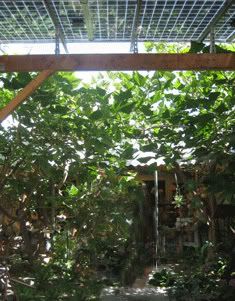
Solar panels don't have to fight for space on green roofs. Two experts suggest combining solar with green roofs works best.
Photobucket

If a solar roof is placed over plants, both the roof and the plants do better. The plants make the solar panels more efficient, because their evaporation cools the back of the exposed panels. Solar panels work better when they are cool.

Likewise, the dappled shade that the solar panels provide the plants below is similar to the canopy effect of taller trees protecting plants underneath from harsh direct sun.

That is the finding of Neubrandenburg Professor of Landscape Ecology Manfred Köhler, who has been involved with research on green roofs and façade greenery since 1981.

In his paper, Positive Interaction between PV-systems and Extensive Green roofs Dr. Köhler says (rough translation)

On some of these greened roofs a photovoltaic –research power plant (PV) was installed in 1999.

Results: Under the shade of the PV panels the vegetation is modified significantly. It changed from a Moss-Sedum roof to a vegetation stand dominated by higher taller plant species likArtemisia and other. The biomass of plant species increased through the years.

A green roof reduces the maximum temperature during the day time. This has a positive influence on the production of electricity by the PV-panels and makes them more efficient in the summer months.
The CEO of nanosolar has said the same thing. Solar panels can be arranged to drip water for plants underneath:

"In a municipal solar power plant, solar panels are mounted onto rails above the ground so that grass and flowers can continue to flourish in between and below the rows of panels. Care is taken that sufficient amounts of rainwater can drop through between adjoining panels so that the flowers and organisms below are not starved. In fact, in dry regions, the solar panels even benefit the ecosystem by increasing the moisture level in the soil.

This synergy is good news, not just for us as homeowners going green, but also for us as a nation.

The Solar Grand Plan published in Scientific American last December said we could power 1/3 of the nations electricity with 30,000 square miles of photovoltaic arrays.

That sounds like a lot of space, but that is actually less square miles than coal per gigawatt produced, when you include the mined areas, not merely coal power stations. It seems like a lot because its all in one place, unlike coal mines.

More than enough land in the Southwest is available without requiring use of environmentally sensitive areas, population centers or difficult terrain, says the NREL. More than 80 percent is not privately owned. Arizona is very interested in developing this solar potential because coal is water intensive. This could eliminate the need for more than half the nation's coal plants.

And even better for the solar grand plan to be designed to allow some desert plant growth underneath in the dappled shade that could cool the panels in that hot Southwest sunshine. If the installation were designed as recommended by the green roofing professor and the solar CEO, we might have the best of both worlds.

Photo from Green Roof Magazine

For Matter Network Read more...