We will close towns, stop growing food and stop making electricity. Two towns are being evacuated because they have
almost run out of water and cannot afford to indefinitely cart supplies.
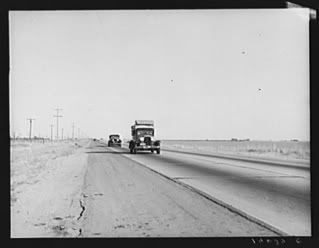
This news story is reality today. Its just not happening in your neighbourhood. Yet. Its from Australia, where
our future climate awaits us. They have had a 12 year drought, doubling
desertification.
The percentage of Earth's land area stricken by serious drought more than doubled from the 1970s to the early 2000s.
The IPCC's second report includes an astonishing prediction that temperatures in the American West and Southwest will increase by an average of
nine degrees fahrenheit by the end of this century.
The next century will be like a permanent 1930s The American Southwest will be in perpetual drought for the next 90 yearsOne thing that is not coming across to the casual reader of the MSM on the IPPC reports is that individual areas have very different forcasts. The West and the Southwest is one of the areas expected to get hotter and drier. So I read Australian newspapers now for my weather impacts, the way I used to read Arabian newspapers after 911.
two of Australia's largest cities, Brisbane and Adelaide -- home to a combined total of almost three million people -- would run out of water by the year's end unless the so-called "Big Dry" ended.
"We could see a catastrophic situation developing here by the end of the year. It's become a huge issue," Flannery told AFP.
"Even a year ago this would have been unthinkable. I think it's the most extreme and the most dangerous situation arising from climate change facing any country in the world right now.
Many deniers
cannot comprehend that flash floods
 "Increased Precipitation"
can go hand in hand with drought. Or the Lutzian phrase:
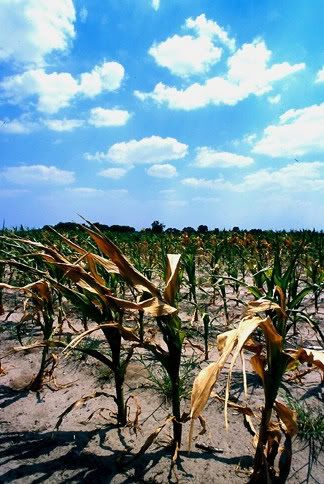 "Longer Growing Seasons"
While our future winters will have increased runoffs, our future summers will be
4 degrees to 16 degrees hotter during summer heatwaves which could come up to 70 days earlier than usual. This is what is meant by the benign-sounding "longer growing season".
Results show summer average temperature increases of 2-5oC under the lower B1 scenario and 4-8oC under the higher A1fi scenario. As heat waves become longer and more frequent, projections for California indicate the heatwave onset will occur by as much as 30 days earlier than present by 2050 and 70 days earlier by 2099.
Who will thrive in this new world? Not humans.
So, indeed, we will have
"longer growing seasons". Sounds great. But here is our water supply to irrigate those longer growing season, per the IPPC.
We will have reduced runoff from earlier snow melt. In droughts, rainfall falls mainly on the ocean...By summertime, that longer growing season is deprived of water
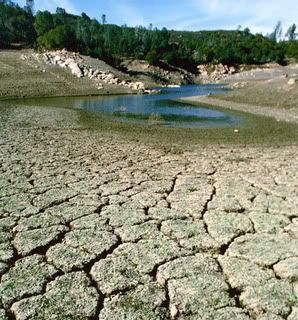
and here we are fleeing longer growing seasons last time.
20 Apr 07
Drought-Hit Australia to Stop Irrigating Food Bowl
CANBERRA - Australia faced an "unprecedentedly dangerous" drought and unless rain falls within weeks irrigation will be cut to the nation's food bowl, Prime Minister John Howard said on Thursday.
"It is a grim situation and there is no point in pretending to Australia otherwise. We must all hope and pray there is rain," Howard told a news conference at Parliament House in Canberra.
Parts of Australia have been in the grip of drought for a decade and the dry is expected to wipe up to one percent off the A$940 billion (US$789 billion) economy in 2006-07.
The basin covers an area the size of France and Spain and accounts for 41 percent of Australia's agriculture.
The country's worst drought in 100 years has already severely reduced production of major irrigated crops. "If it stays dry there will potentially be catastrophic losses," he said.
It is not only our future food supply.
The IPPC says electricity production will be impacted by severe drought, both
directly:
As glaciers disappear and areas affected by drought increase, electricity production for the world’s existing hydropower stations will decrease. Hardest hit will be Europe, where hydropower potential is expected to decline on average by 6 percent; around the Mediterranean, the decrease could be up to 50 percent.
and indirectly
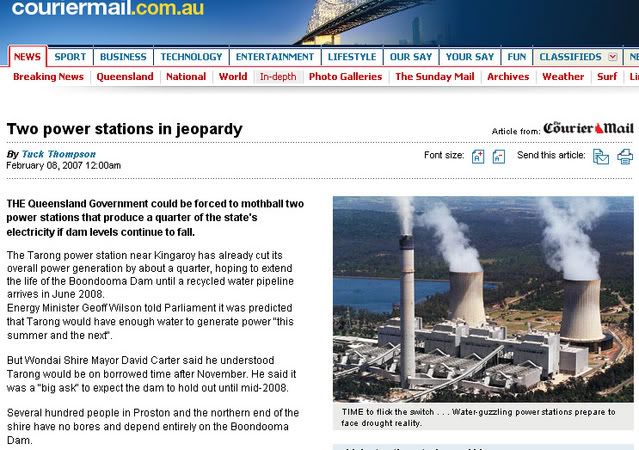
Apparently the human race will realise that we
need to have water to drink more than we need it to turn the lights on at night.
We close towns, stop growing food and stop making electricity. And thats the weather news from the future.Crossposted from
dailykos April 2007
Read more...
 More than a third of Australia's power could be generated by wave technology, according to a report just filed by the engineers who provide scientific measurements for, of all things, the offshore oil industry.

 The day he took office as Prime Minister of Australia, Rudd reversed Howard's fossil-fuelish ways by moving promptly to sign on to Kyoto. He had the support of most Australians:

 Posts


